
Earthworms plow soil by tunneling through it. Their tunnels provide the soil with passageways through which air and water can circulate, and that's important because soil microorganisms and plant roots need air and water. Without some kind of plowing, soil becomes compacted, air and water can't circulate in it, and plant roots can't penetrate it. One study showed that each year on an acre of average cultivated land, 16,000 pounds of soil pass through earthworm guts and are deposited atop the soil (30,000 pounds) in really wormy soil. Earthworm poop, called castings when deposited atop the ground are rich in nitrogen, calcium, magnesium, and phosphorus, these are all important nutrients for healthy, prospering ecosystems. In your own backyard you might be able to confirm that grass around earthworm burrows grows taller and greener than grass just inches away. When it rains earthworms are found all over the pavement. You will find they are everywhere but the grass. This is because when it rains the land gets filled and the worms have to get out of the water. When the rain stops they have a limited time to get back to the grass and into their tunnels because they either become bird food or get dried out by the sun! A typical behavior is to tunnel deeper into the soil, to where conditions aren't so extreme. At a fair depth they roll themselves into balls and excrete mucous around themselves, creating a kind of cocoon. In this state their body functions slow down. They go into a kind of suspended animation, just waiting for soil conditions to improve. At a fair depth they roll themselves into balls and excrete mucous around themselves, creating a kind of cocoon. In this state their body functions slow down drastically. They wait in this state until the soil conditions improve.

Construction of an Earthworm
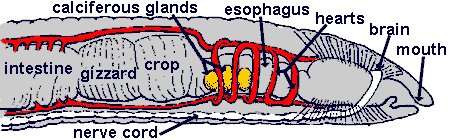
Behavior and Adaptaions Lab | |||||||||||||||||||||||||||||||
| OVERVIEW: Students will work in groups of four to conduct experiments related to the behaviors and adaptations that earthworms have developed for survival in the environment. Two groups of students will conduct experiments related to earthworm reactions to light, two groups will examine moisture preferences, and two will study earthworm responses to odors. At the end of the session students will share results with other groups and discuss their findings in the context of animal adaptations to the environment. TERMS USED: Process related—experiment, control, observation, hypothesis, comparison, classification, prediction, independent variable, inference, data Content related—adaptation, annelid, behavior, burrows, clitellum, consumer, earthworm, environment, food web, gizzard, hermaphrodite, humus, instinct, invertebrate, learning, mucus, nocturnal, nutrients, oligochaetologist, reaction; phylum, setae OUTLINE OF ACTIVITY: In the first half of the workshop we will review previous material and then highlight a researcher at SREL (Karen Gaines) who studies animal behavior. Given the nature of her work (she studies animal populations and communities) we will use slides to introduce the students to “the parts of an ecosystem.” Many of these concepts will be covered in more detail in Activity 5 (e.g., food chains, food webs, predators, prey). In the slide program we will also emphasize that an adaptation is a body part or a behavior that helps an organism meet its needs. In the experiments the students will conduct on worms (see below) the primary emphasis is on how the worm’s behaviors (in addition to its body parts) adapt it to its environment. For the hands-on activity students will work in pairs, with the pairs at a given table conducting the same experiment to ensure replication. Four pairs of students (2 tables of 4 students each) will conduct an experiment using light, another set of 8 students will conduct an experiment using moisture, and a third group will conduct trials using odor. For each experiment the pair of students will make a prediction of the worm’s behavior, and then test four worms in the experimental chambers. Each trial should take approximately 15 minutes (2 trials/experiment). While students are waiting for the experiments to finish they will observe and make notes on worm behavior. After each pair/group has completed their designated experiment the pairs, groups, and entire class will share results.   | |||||||||||||||||||||||||||||||
**I got this lab at http://www.uga.edu/srel/kidsdoscience/kidsdoscience-behavior.htm**

hey Kira! I think that this is a great blog. you did so well doing all of your research about the worms. You also have a great outline and overview of what you would do in the classroom with your students. I think that you created a great hands on experience for the students to experience in the class. This is a very informative blog!
ReplyDeleteWow! This was a really great post! I would definitely be able to use this in my future classroom, the amount of detail is great!! Keep up the great job, I really enjoy reading your posts! :D
ReplyDelete